


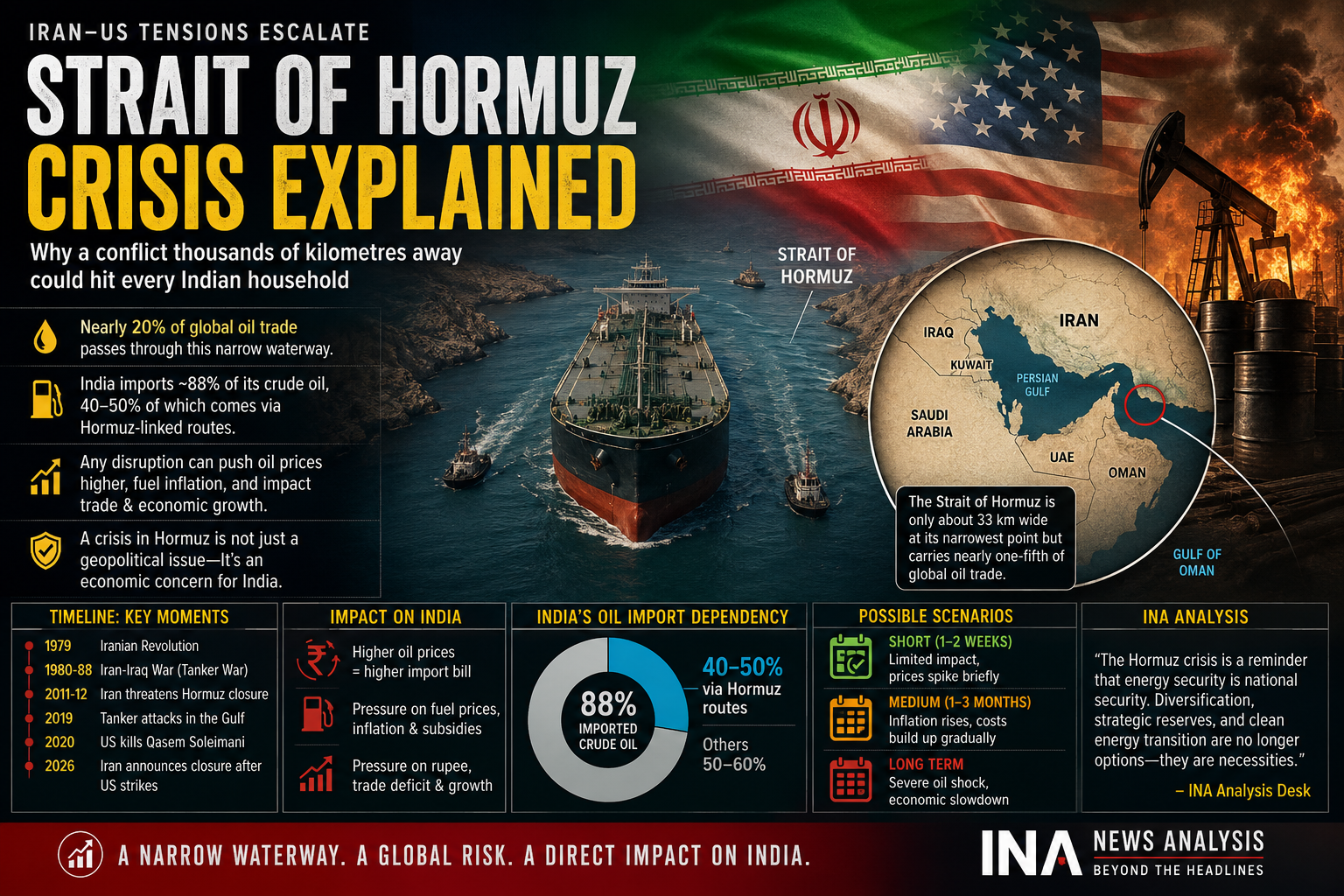
Iran’s latest move against the Strait of Hormuz has pushed oil prices higher and revived fears of a global energy shock. For India, the issue is not just geopolitics—it is about fuel prices, inflation, trade, and economic stability.
A Narrow Waterway, A Global Shock
A military confrontation between the United States and Iran has once again turned one of the world’s most important maritime routes into a geopolitical flashpoint.
Following fresh US strikes on Iranian targets, Tehran announced the closure of the Strait of Hormuz, warning that vessels attempting to pass through the strategic waterway could face military action. The announcement immediately pushed global oil prices higher, with Brent crude moving closer to the psychologically important $100-per-barrel mark.
At first glance, the crisis appears to be a distant Middle Eastern conflict. Yet for India, the consequences could be felt far closer to home—in fuel stations, LPG cylinders, transport costs, food prices, airline tickets, and even household budgets.
The question is no longer whether the Strait of Hormuz matters. The question is how much disruption the world—and India in particular—can absorb if tensions continue to escalate.
What Exactly Happened?
The latest escalation follows renewed military exchanges between Washington and Tehran.
According to international reports, US forces carried out strikes against Iranian military infrastructure, prompting retaliation from Iran. Tehran subsequently declared the closure of the Strait of Hormuz, a critical maritime chokepoint through which a significant share of global oil and gas supplies move every day.
Iranian authorities warned that vessels attempting to use the route could become targets, while the United States disputed claims that commercial shipping had completely stopped. Nevertheless, markets reacted immediately because even the perception of risk in Hormuz is enough to disrupt energy supplies and shipping insurance costs.
Why Is the Strait of Hormuz So Important?
The Strait of Hormuz is a narrow water passage connecting the Persian Gulf with the Gulf of Oman and the Arabian Sea.
Although relatively small on the map, it functions as one of the world’s most important energy arteries.
Roughly one-fifth of global oil and gas shipments normally pass through this route. Major energy exporters such as Saudi Arabia, Iraq, Kuwait, Qatar, and the United Arab Emirates depend heavily on it to reach international markets.
For decades, analysts have referred to Hormuz as the world’s most important energy chokepoint because any disruption there immediately affects global supply chains.
Why India Cannot Ignore This Crisis
India is among the world’s largest energy importers.
The country imports around 88 percent of its crude oil requirements. Research estimates suggest that roughly half of India’s crude imports usually arrive through routes linked to the Strait of Hormuz. In addition, most imported LPG and a significant share of LNG supplies also depend on this corridor.
This means that when tensions rise in Hormuz, India faces three immediate challenges:
1. Higher Crude Oil Prices
Oil markets react not only to actual shortages but also to the possibility of shortages.
The latest announcement from Iran pushed crude prices sharply higher within hours. Investors fear that prolonged disruption could tighten global supply and push prices toward or beyond $100 per barrel.
For India, higher crude prices eventually increase the cost of importing energy.
2. Inflation Risks
Expensive oil affects almost every sector of the economy.
Transportation becomes costlier. Manufacturing expenses rise. Logistics costs increase. Agricultural inputs become more expensive. Over time, these pressures can feed into retail inflation.
This is particularly significant because India has spent much of the past few years attempting to maintain inflation within a manageable range while supporting economic growth.
3. Pressure on the Rupee
India pays for most imported crude in dollars.
A prolonged increase in oil prices increases the country’s import bill and can widen the trade deficit. Historically, such situations have often created pressure on the rupee and increased concerns among investors.
Could Petrol and Diesel Prices Rise Immediately?
Not necessarily.
India’s fuel pricing system and taxation structure mean that international price movements do not always translate instantly into retail fuel costs.
Oil marketing companies often absorb short-term fluctuations. Existing inventories also provide some cushion.
However, if crude remains elevated for weeks or months, retail prices eventually come under pressure.
The duration of the crisis will therefore matter more than the initial shock.
Is India Better Prepared Than During Earlier Oil Shocks?
Compared with previous decades, India is more diversified.
Recent reports indicate that Indian refiners have expanded purchases from countries such as Brazil, Venezuela, Angola, Nigeria, and Russia to reduce dependence on any single route or supplier.
India also maintains strategic petroleum reserves and has repeatedly emphasized energy security as a national priority.
Analysts note that India possesses roughly several weeks of crude and petroleum-product coverage through a combination of strategic reserves and commercial inventories, providing a buffer against immediate disruptions.
Yet diversification does not eliminate vulnerability. A sustained disruption of Hormuz would still increase costs because alternative supplies are generally more expensive and require longer transportation routes.
The Bigger Geopolitical Question
The Strait of Hormuz has long been Iran’s most powerful strategic lever.
Whenever tensions with the United States or its regional allies escalate, Tehran’s ability to threaten energy flows becomes a central factor in negotiations.
Historically, complete closure of the waterway has been difficult because Iran itself depends on maritime exports. However, experts argue that a total shutdown is not always necessary. Even limited attacks, military threats, or higher insurance premiums can discourage shipping companies and reduce traffic volumes.
In energy markets, fear alone can be enough to move prices.
What Happens Next?
Three broad scenarios are possible:
Scenario One: Rapid De-escalation
Diplomatic mediation succeeds, shipping resumes normally, and oil prices gradually stabilize.
This would be the least disruptive outcome for India and the global economy.
Scenario Two: Prolonged Standoff
Military tensions continue without a full-scale war.
In this case, oil prices may remain elevated, shipping costs could rise, and inflationary pressures would gradually build across major importing economies.
Scenario Three: Wider Regional Conflict
A broader conflict involving multiple regional actors could create a severe supply shock.
Such a scenario would significantly increase energy prices, disrupt trade routes, and raise recession risks in several economies.
INA Analysis: The Real Story Is Energy Security
The latest Hormuz crisis is not merely a military confrontation between Iran and the United States.
For India, it is a reminder of a deeper structural challenge: despite rapid economic growth, the country remains heavily dependent on imported energy.
Every disruption in the Middle East exposes this vulnerability.
The immediate headlines focus on missiles, airstrikes, and naval movements. The more important long-term story is whether India can accelerate diversification of energy sources, expand strategic reserves, strengthen renewable capacity, and reduce exposure to geopolitical chokepoints.
The Strait of Hormuz may be thousands of kilometres away from India, but its impact reaches directly into the Indian economy. As oil markets react to the latest escalation, policymakers in New Delhi will be watching not just the conflict itself, but how long it lasts.
Because in today’s interconnected world, a narrow waterway in the Persian Gulf can influence everything from inflation data in Delhi to the monthly budget of an average Indian family.
