


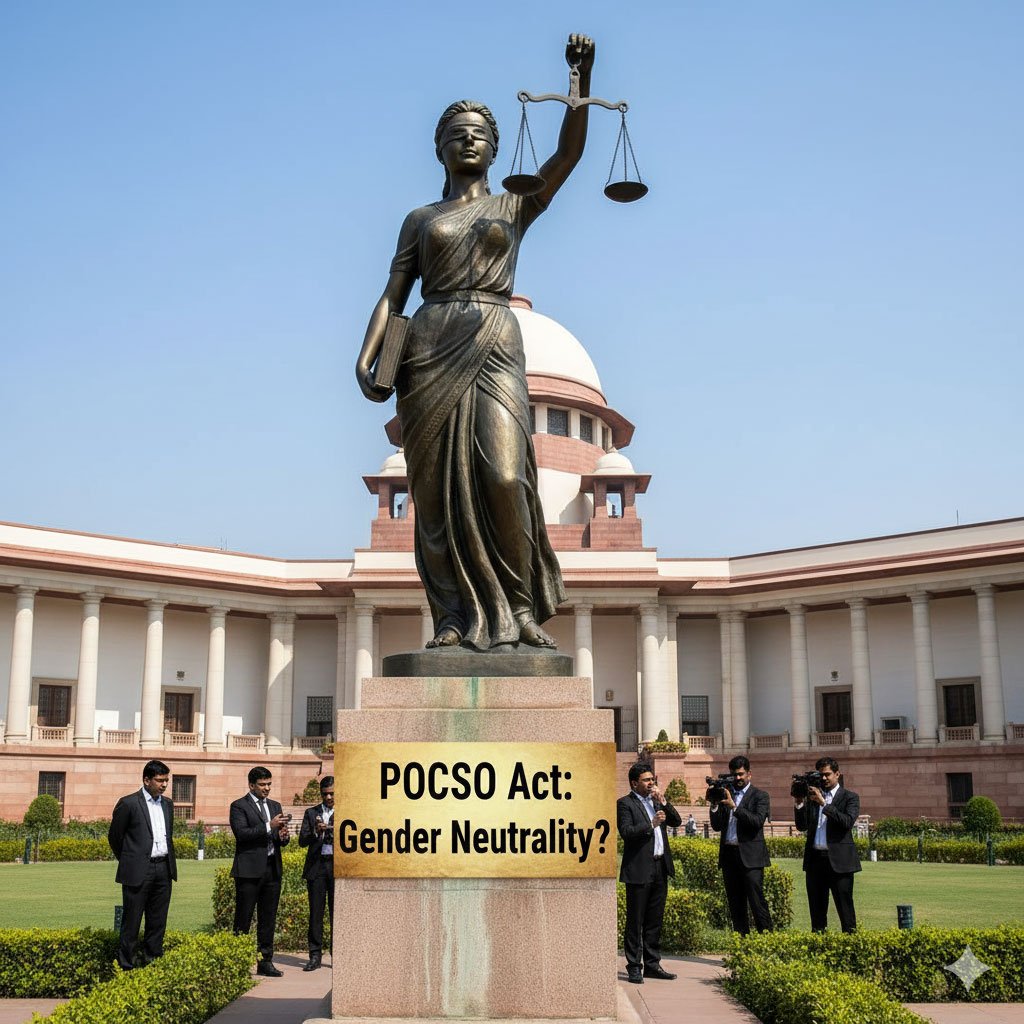
The Supreme Court has agreed to examine whether the Protection of Children from Sexual Offences (POCSO) Act, 2012, is gender neutral, after a woman accused of sexually assaulting a 13-year-old boy challenged the applicability of the law to female offenders.
A Bench comprising Justice M.M. Sundresh and Justice Satish Chandra Sharma issued notice on the plea filed by the accused, Archana Patil, and stayed further proceedings before the trial court until further orders.
Senior advocate Hashmath Pasha, appearing for Patil, argued that Sections 3(1)(a) to 3(1)(c) of the POCSO Act—dealing with penetrative sexual assault—are gender-specific and refer only to male perpetrators, using the pronouns “he” and “his.”
The Legal Question
Section 3 of the POCSO Act defines “penetrative sexual assault” and includes several clauses that describe acts committed by “he.” The relevant provision states:
“A person is said to commit ‘penetrative sexual assault’ if—
(a) he penetrates his penis, to any extent, into the vagina, mouth, urethra or anus of a child or makes the child do so with him or any other person; or
(b) he inserts, to any extent, any object or a part of the body, not being the penis, into the vagina, the urethra or anus of the child or makes the child do so with him or any other person; or
(c) he manipulates any part of the body of the child so as to cause penetration… or makes the child do so with him or any other person.”
Patil’s petition contends that the use of masculine pronouns indicates the law was framed with male perpetrators in mind and therefore cannot be invoked against women.
Background of the Case
The case stems from allegations made by the parents of a 13-year-old boy, who claimed that Patil, a 48-year-old neighbour, had sexually assaulted their son between February and June 2020 when he attended her house for art lessons.
Following investigation, the police filed a charge sheet under Sections 4 and 6 of the POCSO Act, which prescribe punishment for penetrative sexual assault and aggravated penetrative sexual assault, respectively. The case was registered before the Fast Track Special Court-I in Bengaluru.
Karnataka High Court’s Ruling
Earlier, the Karnataka High Court had dismissed Patil’s plea seeking to quash the case, holding that the POCSO Act is gender neutral.
“The Act, being a progressive enactment, is intended to safeguard the sanctity of childhood,” the High Court observed. “It is rooted in gender neutrality with its beneficent object being the protection of all children, irrespective of sex. Although certain provisions may employ gendered pronouns, the preamble and purpose of the Act render such usage inclusive.”
The High Court concluded that the law’s protective scope extends to all children and that its provisions apply equally to male and female offenders.
Supreme Court Intervention
The Supreme Court, however, has now decided to examine whether this interpretation holds. Issuing notice on Patil’s plea, the Court said:
“Issue notice. In the meantime, further proceedings before the Trial Court shall remain stayed.”
The outcome of this case could have significant implications for how the POCSO Act is interpreted in cases involving female accused persons, potentially prompting a broader legal debate on the gender neutrality of sexual offence laws in India.
